By: Ronnie Miles, NGCOA, Senior Director of Advocacy

.
Across the United States, communities are confronting increasingly difficult questions about water. Population growth, drought, reduced snowpack, agriculture, development and emerging industries are placing additional demands on a resource essential to our communities and economy.
Golf is part of that conversation, and it should be.
Golf courses require water to maintain healthy turf and playable conditions. But public discussion about golf and water can sometimes begin and end with one image: a green golf course in a community where residents are being asked to conserve.
That image does not tell the whole story.
The more meaningful questions are: How much water does golf use? What kind of water is being used? How efficiently is it being applied? And what is the industry doing to reduce future demand?
The answers demonstrate considerable progress, while reinforcing golf's responsibility to continue improving.
.
Golf Has Reduced Water Use by 31%
Over the past two decades, the golf industry has invested heavily in irrigation technology, turfgrass research, water conservation and professional education. According to the Golf Course Superintendents Association of America's Golf Course Environmental Profile, U.S. golf facilities reduced irrigation water use by approximately 31% between 2005 and 2024, from roughly 2.38 million acre-feet to 1.63 million acre-feet annually.
That reduction did not happen by accident. Today's golf course superintendent manages water using technology and science most people driving past a golf course never see. Modern facilities may employ weather stations, computerized irrigation controls, soil-moisture sensors, handheld moisture meters, wetting agents, drought-tolerant turfgrasses and increasingly precise irrigation systems.
As GCSAA's Michael Lee has observed, this creates a unique communications challenge. Someone may drive past a green golf course during drought conditions and wonder why the course looks healthy while homeowners are being asked to reduce outdoor watering. What that person cannot see is the technology beneath the turf, the superintendent's agronomic education and training, the moisture measurements being taken, or the source of the water being applied.
.
Where Golf Gets Its Water Matters
One of the biggest misconceptions about golf is that courses primarily use municipal drinking water for irrigation. The national data tell a very different story. A green golf course does not necessarily mean a wasteful golf course.
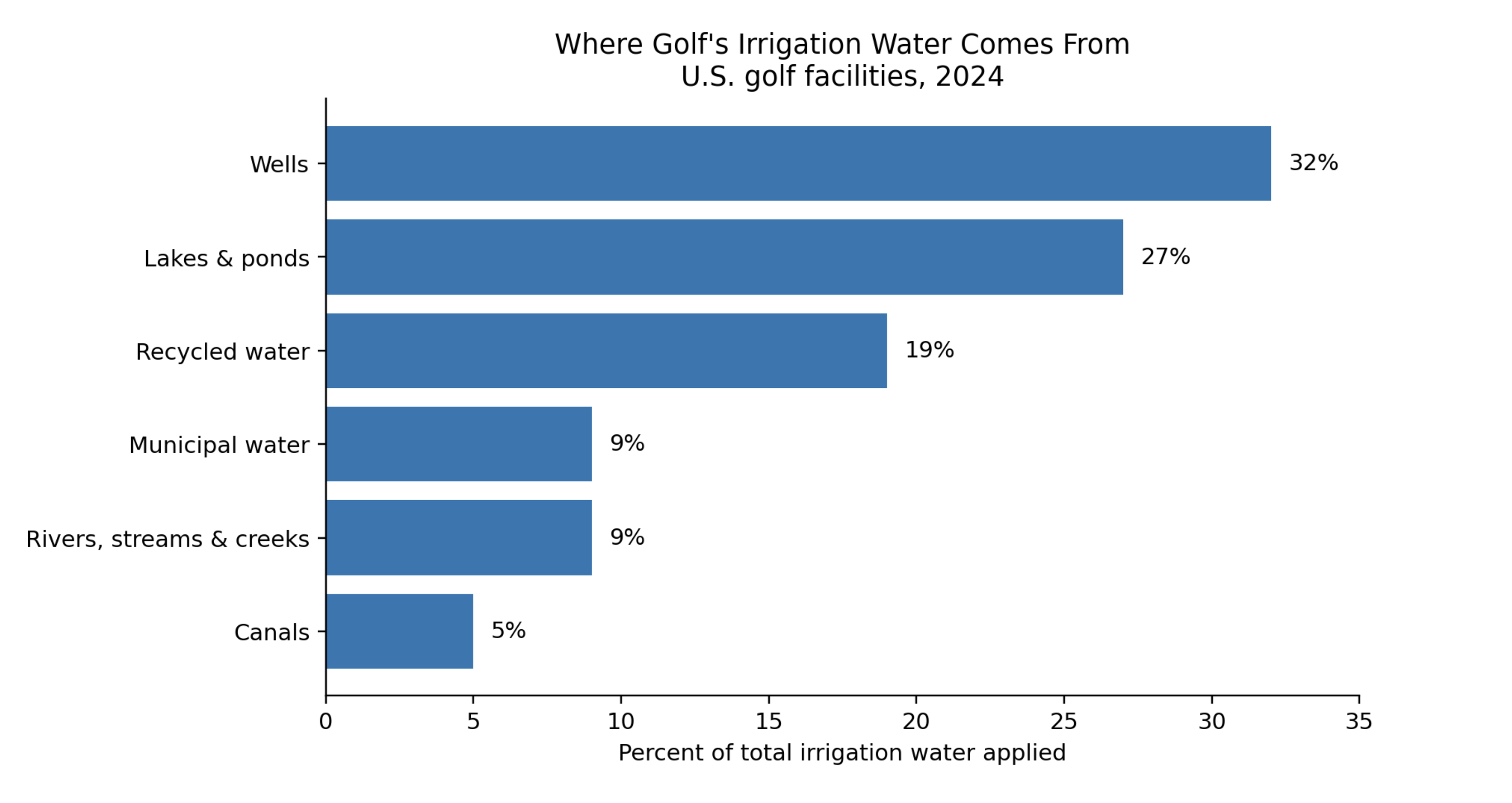
| Figure 1. Share of total irrigation water applied by U.S. golf facilities, 2024. Source: GCSAA Golf Course Environmental Profile, Phase IV, Water Use and Conservation Report. Percentages may not total 100% due to rounding. |
.
GCSAA reports that approximately 32% of golf irrigation water comes from wells, 27% from lakes and ponds, and 19% from recycled water. Municipal water represents approximately 9% of total irrigation water applied.
Put another way, approximately 78% of golf irrigation water comes from wells, lakes and ponds, or recycled supplies. There is an important qualification. "Municipal water" should not automatically be interpreted as "potable water." Municipal systems and reporting definitions vary. Nevertheless, the national data demonstrate that municipal systems are only one component of a much broader irrigation portfolio.
That is why simply asking, "How much water does golf use?" provides an incomplete picture. We should also be asking: "What kind of water is golf using?"
In many communities, golf courses provide a productive destination for recycled wastewater. Courses can also capture stormwater, store water in ponds and reservoirs, and utilize groundwater and other sources that can reduce pressure on community drinking-water supplies.
.
Putting Golf's Water Use in Statewide Perspective
Water conditions differ dramatically across the United States. Climate, rainfall, water rights, population, agricultural demand and the availability of reclaimed water all influence how golf facilities operate.
Available figures from several states where water policy is especially important help put golf's demand into perspective.
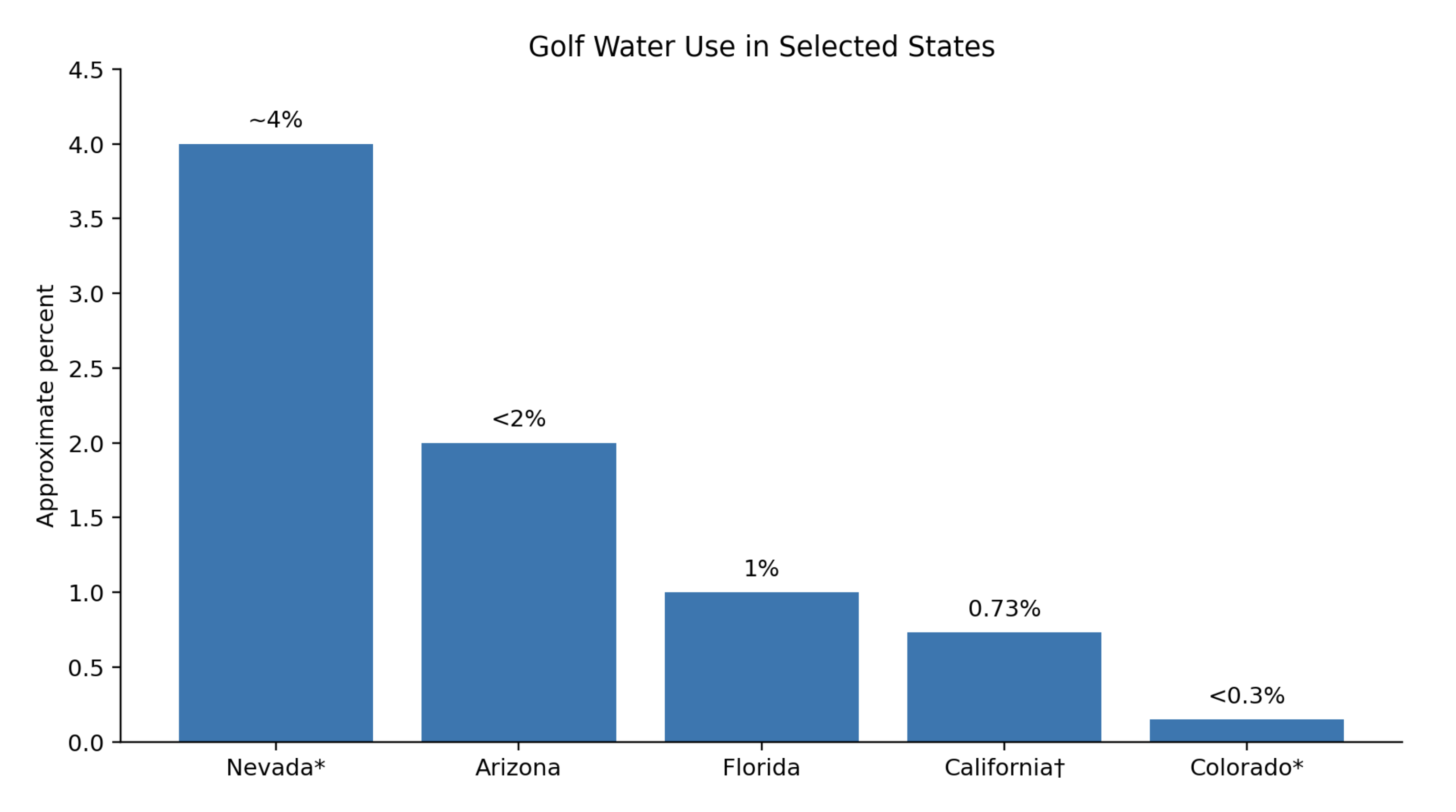
| Figure 2. Illustrative golf water-use figures for selected states. *Nevada uses the midpoint of an estimated 2%-6% range; Colorado is shown as less than 0.3%. †California's 0.73% figure specifically measures potable water consumption. Arizona is reported as less than 2%. State definitions and methodologies differ, so the figures are not directly comparable. |
.
These numbers should not be viewed as a strict state-by-state ranking because the underlying measurements differ. California's figure, for example, specifically measures golf's share of potable water consumption, while Arizona's figure relates golf to the state's broader water supply.
Nevertheless, they provide useful context. Even in states where golf is economically important and water availability is a major public-policy issue, golf typically represents a relatively small portion of the overall resource. But a small percentage does not eliminate the obligation to conserve.
.
California: 0.73% Is Not an Excuse to Stop Improving
California provides a particularly useful example of that philosophy.
“The California golf community consumes 0.73% of the potable water consumed in the state — a number that is lower than it was just a few years ago and a number that the golf community is committed to lowering further, because if all the many 0.73% users of potable water in California use that small number as an excuse to discontinue their conservation efforts, the state will arrive at 2050 incapable of supporting the economic and population growth central to maintaining California as the 4th largest economy in the world.” —Craig Kessler, California Alliance for Golf
That commitment is translating into changes on the golf course. Kessler points to the increasing regrassing of California golf courses with drought-tolerant varieties of Bermudagrass that require considerably less water than the grasses they replace. In many cases, these grasses also allow courses to eliminate water-intensive winter overseeding, providing an additional opportunity to reduce annual irrigation demand.
Importantly, the golf industry is not simply adopting new technology; it is helping develop it. "One of the drought-tolerant turfgrass varieties now being used was developed through the turfgrass program at the University of California, Riverside, a program funded almost entirely by the California golf industry,” says Kessler.
This provides a tangible example of what continued water stewardship looks like: investing in research, adopting grasses that require less water, changing long-standing maintenance practices, and reducing potable water demand without sacrificing the recreational and economic benefits golf provides.
Golf can place its relatively small share of statewide potable water consumption in perspective, but as Kessler makes clear, 0.73% is not the finish line.
.
Arizona: Less Than 2% With More Work To Do
Arizona's golf industry is taking much the same approach.
“In Arizona, the golf industry accounts for less than 2% of the state’s total water supply. But we aren't putting a period at the end of that sentence. Instead, our industry is proactively continuing its investments in systems, research, and operational practices to refine and reduce that number year over year.” — Katie Prendergast, Arizona Alliance for Golf.
The percentage provides perspective. It does not provide an excuse.
.
Green Does Not Mean Wasteful
Golf faces a perception challenge that many other industries do not. Successful water conservation can be almost invisible.
When an irrigation system becomes more efficient, the objective is still healthy turf. When a course converts from potable water to recycled water, neighbors may see no visible difference. When a superintendent uses moisture sensors to avoid unnecessary irrigation, the course may still look green.
Appearance therefore tells us very little about how much water was applied or where that water originated. A superintendent may be monitoring weather conditions, measuring soil moisture before operating an irrigation head, watering only specific areas that require it and using recycled water to do so. To someone driving past, however, it simply looks like a green golf course.
That is why conservation and communication have to work together.
.
New Competition for Water Resources
Golf is also only one of many sectors confronting increased scrutiny over water.
Agriculture remains the dominant user in many parts of the country. Population growth increases municipal demand. Manufacturing and energy production require water. More recently, rapid growth in artificial intelligence and the data centers supporting it has introduced another significant source of demand.
Data centers can use considerable quantities of water directly for cooling computer equipment. Their substantial electricity requirements can also create an indirect water footprint because some forms of power generation require water for cooling.
Comparing golf and data centers strictly by gallons can be misleading because the industries use water differently. Golf primarily manages living landscapes and has increasingly incorporated wells, surface water and recycled supplies. Data centers use water primarily for cooling and are themselves investing in recycled water, closed-loop systems, air cooling and other conservation technologies.
Every industry that depends on water should be prepared to explain how much it needs, where that water comes from, how efficiently it uses it and what it is doing to reduce future demand.
Golf should expect to meet that standard, just as technology companies, agriculture, manufacturers, municipalities and other water users should.
.
Every Golf Course Has a Water Story
The golf industry's next challenge is not simply continuing to reduce water consumption. It is becoming better at explaining what is already happening.
Golf course owners, operators, superintendents and PGA Professionals should know the answers to basic questions about their own facilities: Where does our irrigation water come from? How much is reclaimed or otherwise non-potable? How has our consumption changed? What technology have we invested in? Have we reduced irrigated acreage? What agronomic practices are lowering demand? What are we planning to do next?
These are no longer simply maintenance questions. Increasingly, they are advocacy questions.
Michael Lee, Senior Manager, Government Affairs, GCSAA, has highlighted the opportunity presented by golf professionals, who are among the most public-facing individuals at a golf facility. They interact every day with golfers, business leaders, community officials and policymakers.
When those professionals understand what their superintendent and maintenance team are doing, they become additional credible voices capable of explaining golf's water story.
That becomes especially important when elected officials and regulators make decisions regarding drought restrictions, conservation requirements and water allocations that may directly affect golf facilities.
.
The Goal is Not to Defend Every Gallon
Golf's strongest argument is not: "We use a small percentage, so leave us alone."
It is: "We understand the value of water, we have made measurable progress, and we intend to keep improving."
The industry's record demonstrates that improvement is possible. National irrigation water use has declined 31% since 2005. Recycled water represents a significant component of golf's irrigation supply. Technology has made irrigation more precise. Turfgrass research continues producing grasses capable of maintaining quality while requiring less water.
But the work is not finished.
The western United States faces continued uncertainty from drought, changing snowpack and pressure on resources such as the Colorado River. Other regions are confronting population growth, groundwater depletion, saltwater intrusion and competing municipal demands.
Golf therefore has two responsibilities: continue reducing the amount of water required to maintain healthy, playable courses, and become much better at explaining how that water is being responsibly managed.
The public has every right to expect golf to use water wisely. Golf should expect the same of itself.
Because the most compelling story the industry can tell is not simply how much water golf uses. It is where that water comes from, how efficiently it is used, and what golf is doing to use less tomorrow than it does today.
.