 By Harvey Silverman, Contributor, Golf Business | Silverback Golf Marketing
I have attended every PGA Show (formerly the PGA Merchandise Show) since 1997, save three or four. This year reminded me of 1999 and 2000, during the “Tiger Boom” and before the bursting of the Internet bubble and the aftermath of 9/11. The hall was full from end to end, and even had some exhibitors in the main hallway. I finally found time late Thursday and Friday morning to do some roaming, hunting for possible subjects for my NGCOA Golf Business LIVE – Tech Talks (you all tune in, right?). That being said, I missed out on seeing 75% of the show — especially the apparel section.
The crowd was noisy and robust, and the overall atmosphere was electric – and that’s not referring to the sudden emergence of several new electric golf car companies. It used to be just Club Car and EZ-Go, then Yamaha entered the market. Now? It seems there are as many electric car companies as simulator companies taking up huge amounts of valuable floor space.
Just down the aisle from the NGCOA booth (which needs to get bigger based on crowds and visitors they see each day) was the new Lamborghini golf car. I don’t know if we’ll ever see one rolling around The Villages, but I suspect there’s a niche market where golf cars carry equal status with top-end, luxury automobiles. That’s me in the Lambo, probably as close as I’ll ever come to actually driving its auto namesake.
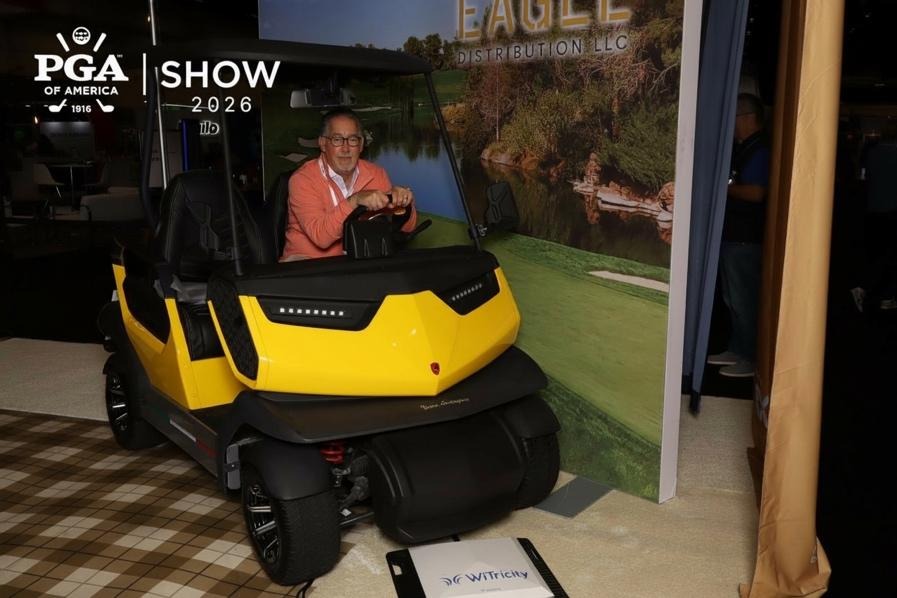
Intriguing me, along with the Lambo, was a company called “WiTricity,” which featured wireless charging for electric carts (which begs the question – when are golf courses going to finally switch out the noisy, smelly, polluting gas cars for quiet, eco-friendly electric cars?). The wireless pads installed on the car barn floor solve the problem courses are facing: lithium-ion batteries and insurance companies that are balking or outright denying coverage because of the risk of fire when a lithium-ion battery overheats while plugged in and charging. The risk of fire is why airlines don’t allow lithium-ion batteries in checked luggage.
I visited a course in Orlando that had brought in a huge new fleet (not from the companies mentioned above) of lithium-ion powered golf cars, only to be told by the facility owner that they could not be stored in the barn. So, a major switch-out back to lead-acid had ensued, a costly and disruptive process. But now, just as we can charge our phones wirelessly, WiTricity offers a solution that could make lithium-ion the new standard for golf car power and be accepted by insurance companies.
People use the word “genius” so loosely that it often just means “I like this” or “that was clever,” instead of something rare and extraordinary. So it was when I saw a press release about the “Genius” ball, I thought, “yeah, right.” Boy, was I wrong. I visited the Genius booth and was mesmerized by watching the great Dave Stockton, who claims to hold the PGA Tour record for most consecutive holes played without a three-putt, demonstrate a ball that has all the measurements of a regulation golf ball, but contains a sensor that sends critical data via Bluetooth to the putter’s phone. Impact, launch, skid, speed, and rollout are measured and scored with a ball whose battery will last for 10,000 putts. And if your stroke needs help, instructional videos are available by scrolling through the app. That, my friends, is genius. I signed up for mine. I’ll let you know how they roll.
* * *
Flying alone and choosing a seat on a plane is always a stress-filled endeavor. Will you end up sitting next to someone who pulled out their three-day-worn Fruit of the Loom white tee shirt with the ketchup stains and thought, “Yeah, this is good to fly in”? Or someone who uses the six-hour flight back to San Francisco for toenail clipping?
But on my flight home this year, I had the fortuitous chance to meet a young man I’d seen posting on LinkedIn. He plopped down next to me at the last minute, out of breath, but with a “Demo Day” hat that identified him as a PGA Show attendee. It was his first show, and he was spellbound by the size and energy he witnessed. I love listening to firstcomers’ reactions.
There are plenty of technologies that advertise how they can make life better, and that’s mostly hype. I love technology that solves a problem, a real problem. My seatmate was Owen Quinn, founder of Found It Golf. The problem Owen solves is how to return the 2.5 million lost clubs (according to the NGF) and the untold number of personal rangefinders (according to no one, because people are too embarrassed to admit it) to their rightful owners. I thought 2.5 million sounded like a lot until I asked several operators and got a rough average of 200 annually, plus a drawer or box full of rangefinders. It seems that rangefinders can find the flags on the greens, but can’t find you when it’s left behind. Until now.
Owen’s creation was hatched while working in the bag room at a prestigious private club here where I'm from in the Bay Area, where the $400K spare change you have lying around can get you on the wait list. Despite their status, members and guests were not immune to leaving a wedge alongside the 14th green or a putter on 18. It happens to the best of us. And now, it was Owen’s job to find the owner.
Found It Golf is a label with a unique QR code attached to the butt end of the golf grip or to the range finder (or phone, wallet, anything other than the money you lost). When scanned, it tells the scanner who the club owner is and how to contact them, and it tells the club owner that the club has been found and where it is. The labels are shipped in groups of 15. Assuming you carry a legal set of 14 clubs, that 15th label goes on the rangefinder or anything else. The QR-coded label can be white-labeled with the facility’s name at twelve o’clock, its logo at three and nine, and “Scan if found” at six o’clock. At $25 MSRP, it adds a new level of service for private clubs, and any facility that replaces grips and fits and sells new clubs. Owen is looking for ways to bring Found It Golf to market beyond direct-to-consumer sales on his website. If you have ideas, let me know, and I’ll forward them to Owen and help eliminate the barrel full of lost clubs seen in golf shops everywhere.
Last, a shoutout to my friend Kevin Carpenter (the GratiDude). It’s great to see him back in the game as U.S. Managing Director for AM Golf, coming to the U.S. market from Europe. Kevin is a former nemesis (GPS sales) who I’ve admired for his tenacity, perseverance, openness, and ability to get people to say, “Yes.” I wish him the best of luck.