By: Ronnie Miles, Senior Director of Advocacy, NGCOA
.
NGCOA undertook this national survey with a straightforward purpose: to better understand what golf facilities are currently doing to monitor and respond to lightning and severe weather, and how widely those practices are being used across the industry. We wanted to establish a clearer picture of the systems, procedures, communications and operational approaches being used by public, private, municipal and resort golf facilities.
Importantly, this survey was not designed to establish industry best practices, set a standard of care or make policy recommendations. Golf facilities differ significantly in geography, size, design, staffing, resources, and exposure to severe weather. Rather than determining what facilities should do, our objective was to better understand what they are doing today.
The survey was distributed broadly, with golf clubs and courses across the country invited to voluntarily participate. Because respondents were self-selected rather than chosen through a randomized sampling methodology, the results should not be interpreted as scientific findings or as statistically representative of every golf facility in the United States. Instead, they provide a useful snapshot of the practices reported by participating facilities and offer insight into the range of approaches currently being used across the industry.
Viewed in that context, the results provide owners and operators with an industry reference point for understanding how other facilities are approaching lightning monitoring and severe weather, communication, and response, while recognizing that every golf operation has its own circumstances and considerations.
Background
Lightning and severe weather are realities golf course owners and operators manage throughout the season. While technology has made weather information more accessible than ever, deciding when to suspend play, how to communicate with golfers, and what responsibility a facility assumes remain challenging operational and risk-management questions.
To better understand how golf facilities are approaching these issues, NGCOA conducted an industry survey examining lightning monitoring, notification procedures, suspension-of-play practices, shelter availability, insurance considerations, and legal involvement.
The results show an industry that takes weather awareness seriously, but also one where practices vary considerably from facility to facility.
Weather Monitoring Is Nearly Universal
One of the clearest findings is that 92% of facilities actively monitor weather conditions during operating hours.
Facilities often use multiple sources rather than relying on a single system. Among the most common tools are smartphone weather applications at 67%, followed by local TV radar at 53% and visual observation at 47%. National Weather Service alerts and dedicated commercial lightning detection systems also play an important role.
The survey found that 51% of facilities reported having access to a dedicated commercial lightning detection system, demonstrating the growing role of specialized technology in weather monitoring.
Technology, however, is only part of the equation. Facilities must still determine who monitors the information, when conditions justify action, and how that decision is communicated to golfers and employees.
Written Procedures Are Far From Universal
While weather monitoring is widespread, formal written procedures are much less common.
Only 38.8% of facilities reported having written lightning or severe-weather procedures. This creates an important distinction between being aware of approaching weather and having a clearly defined process for responding to it.
The survey also found that 71% communicated some form of severe-weather policy or expectation to golfers, while 28% reported having no stated policy communicated to golfers.
For golf course owners and operators, this is an important area to examine. A policy can only be effective if employees understand it, golfers know what is expected of them, and procedures can be implemented consistently.
Terms & Conditions Disclosures: Public vs. Private Facilities
Survey data reveals a sharp operational contrast between public and private facilities when communicating severe weather risks, personal responsibility, and shelter locations through a pre-play "terms & conditions agreement prior to play":
-
Public & Municipal Courses (21%): Public and municipal operations are three times more likely than private clubs to utilize pre-play terms and conditions (21% vs. 7%). Because public courses serve daily-fee players, online bookers, and transient visitors, point-of-sale disclosures and digital check-in agreements serve as a primary touchpoint for communicating policies, responsibilities and weather-related expectations before play.
-
Private Clubs (7%): Private facilities rarely rely on transaction-based terms and conditions. Instead, they overwhelmingly integrate severe weather risks and liability disclosures directly into formal Member Agreements (49%) and membership onboarding documentation to reach their core golfer base.
Facility Type Matters
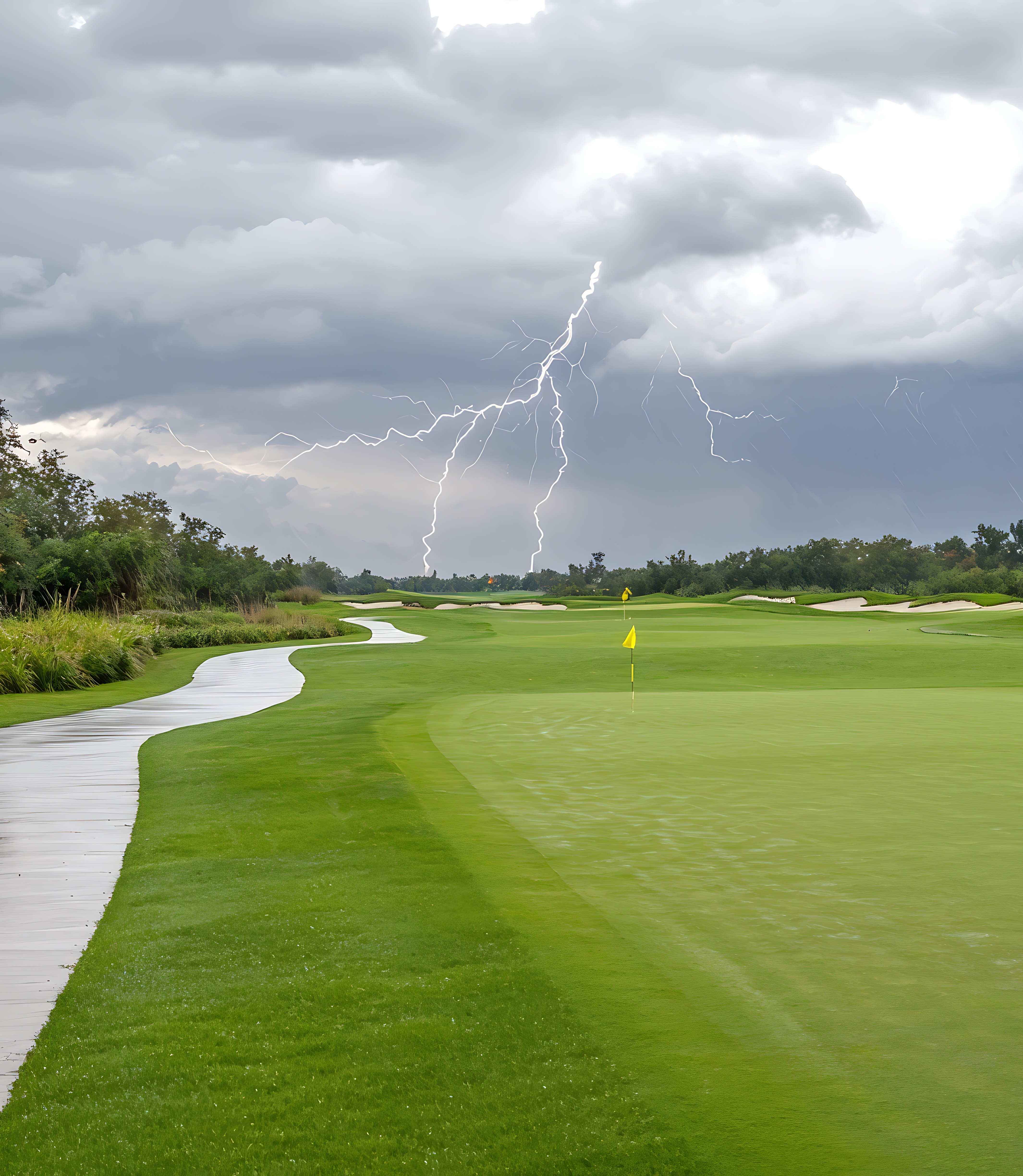 One of the important lessons from the survey is that lightning practices should also be viewed within the context of the type of golf operation. Public and daily-fee courses, private clubs, municipal facilities, and resorts do not necessarily face the same operational circumstances, and the survey responses reflect those differences.
Resort and larger golf operations generally have more extensive infrastructure, staffing and communication capabilities. These facilities may have multiple courses, centralized operations, GPS-equipped carts, dedicated security or guest-services personnel, and greater access to commercial weather-monitoring technology. At the same time, their size can make communication more complicated because golfers, employees and guests may be spread across a much larger property.
Private clubs may have an advantage in communicating procedures to a more consistent population of members. Clubhouse communications, member applications, golf staff and established club policies can provide multiple ways to reinforce severe-weather procedures. However, private facilities still must account for guests, tournaments and outside events where participants may be unfamiliar with club procedures.
Public and daily-fee facilities face a different challenge. Their customers may include local regulars, occasional golfers and first-time visitors, making it more difficult to assume that players understand a facility's warning signals or suspension procedures. Clear communication at check-in, on carts, through signage or through other available channels can therefore become particularly important.
Municipal facilities may operate with different staffing levels, budgets and procurement requirements than privately operated courses. Those differences can influence access to commercial detection systems, communication technology and dedicated shelters.
The survey identified a notable difference in shelter availability based on facility size. 62% of 9-hole facilities reported the clubhouse as their only available safe location, compared with 19% of 18-hole facilities. By contrast, more than 88% of facilities with 27 or more holes reported having additional on-course locations, such as restrooms, halfway houses or designated lightning shelters. This difference likely reflects the greater distances golfers may be from the clubhouse at larger and multi-course properties, as well as the additional infrastructure commonly found at these facilities.
The survey also suggests that facility size and complexity matter alongside ownership type. A smaller golf operation with a single clubhouse and limited staff faces a very different challenge than a multi-course resort where golfers may be miles from the primary clubhouse when weather develops.
These differences help explain why the survey does not point toward a single industry-wide model. What matters is whether the procedures, technology, staffing and communications used by a facility are appropriate for its particular operation.
How Golfers Are Warned Varies Widely
 There is no single industry-wide approach for notifying golfers when severe weather approaches.
Facilities reported using course rangers, GPS systems, horns, sirens, mobile communications and other methods. Approximately 58% use multiple methods to communicate weather warnings, while 12% reported having no specific warning method.
This variation reflects the differences among golf facilities. A compact course surrounding a clubhouse may face very different communication challenges than a resort or multi-course operation covering hundreds of acres.
Regardless of the method, the survey reinforces the importance of making warnings understandable. A horn or siren has limited value if golfers do not know what the signal means or what they are expected to do after hearing it.
Who Makes the Call?
Responsibility for suspending play also differs among facilities.
The survey found that 64.3% use some form of shared decision-making authority, rather than assigning the responsibility exclusively to one individual. Depending on the facility, that responsibility may involve the general manager, golf professional, superintendent or other designated employees.
When determining whether to suspend play, 84% of facilities reported using a defined lightning-distance threshold as part of their decision-making process.
What happens after that decision is made is less consistent.
Approximately 45% instruct golfers to return to the clubhouse, while other facilities direct golfers toward the nearest available shelter or provide different instructions based on course conditions and location.
The survey also revealed different philosophies on whether golfers must stop play. 60% reported mandatory suspension procedures, while 31% indicated that while they advise golfers of impending weather, the ultimate decision may remain with the golfer. 9% follow a strict "Play at Your Own Risk" approach, providing no active monitoring or warnings and placing full responsibility on the golfers.
Shelter Remains an Important Operational Issue
Nearly all facilities, 95%, identified the clubhouse or golf shop as a potential sheltered location. Other available locations include restrooms or comfort stations at 66%, halfway houses at 26%, maintenance buildings at 23%, and dedicated on-course shelters at 18%.
The availability of shelter naturally varies based on course design, acreage, number of holes, and existing infrastructure. That makes it difficult to apply a single approach across the industry.
The more useful question for operators may be whether golfers and employees understand where available sheltered locations are and how they should respond when severe weather develops.
Legal and Insurance Involvement Is Limited
One of the more notable findings involves outside risk-management guidance.
Only 22% of facilities reported consulting legal counsel regarding their lightning policies.
The survey suggests that insurance providers play a role in lightning and severe-weather risk management at some golf facilities, but that involvement is far from consistent. Approximately 23% of respondents reported that their insurance carrier has established some form of requirement related to weather safety, while another 11% indicated that their carrier has provided recommendations but does not mandate specific procedures. The remaining respondents either reported no carrier requirements or recommendations, or did not know whether their carrier had established any guidance.
This finding is notable because insurance providers are often an important source of risk-management guidance for golf course owners. Yet, based on the survey responses, formal carrier involvement in lightning procedures does not appear to be universal. The number of respondents who were unsure of their carrier's position also suggests that weather-related expectations may not always be clearly communicated or regularly discussed as part of the insurance relationship.
Financial incentives for installing specialized technology appear uncommon. Only 5% reported receiving an insurance discount or credit associated with a commercial lightning detection system.
These findings suggest an opportunity for golf course owners to have more detailed conversations with their insurance professionals and legal counsel about existing procedures, documentation, and facility-specific risks.
The Human Factor Remains the Biggest Challenge
Perhaps the most revealing survey finding has little to do with technology.
75% identified golfers ignoring weather warnings as an operational challenge, making it the most commonly cited concern.
Other significant challenges include potential liability at 47%, communicating effectively with golfers at 45%, and determining when play should be suspended at 36%.
Technology costs, employee training, tournament disruptions, and pace-of-play concerns were also identified, but at lower levels.
These results demonstrate why lightning management cannot be viewed simply as a technology issue. Even the most sophisticated detection system cannot force a golfer to respond appropriately to a warning.
Lightning Interruptions Are a Regular Part of Operations
For many golf facilities, suspending play because of lightning is not an unusual event.
32% reported suspending play between one and five times annually, while 20% reported six to 10 suspensions. Another 16% reported 11 to 20, and 17% reported more than 20 suspensions during a typical year.
Regional climate naturally influences those results, but the frequency demonstrates that severe-weather procedures are not simply documents that sit on a shelf. For many facilities, they are operational procedures that may be put into practice repeatedly throughout the season.
What the Survey Tells Us
The survey does not establish a single standard for how every golf course should manage lightning. Golf facilities differ significantly in geography, property size, course configuration, staffing, technology, and available shelter.
Instead, the findings provide an industry benchmark that allows owners and operators to compare their current practices with those being used across the golf industry.
The strongest takeaway may be the gap between weather awareness and formalized response procedures. More than 92% monitor weather, yet fewer than 39% have written procedures. At the same time, nearly three-quarters identify golfers ignoring warnings as a significant operational challenge.
For golf course owners and operators, that creates an opportunity to review not only how weather is monitored, but the entire process that follows: Who makes the decision? What triggers action? How are golfers notified? Where are they directed? What are employees expected to do? And has the process been reviewed with the facility's insurance and legal professionals?
NGCOA's survey provides a clearer picture of how the industry is addressing those questions today. The next step is using that information to help facilities evaluate their own practices, strengthen communication, and make informed decisions appropriate for their individual operations.
.